This I Did
There’s a favorite quote of mine from British Army officer Thomas Edward Lawrence, popularly known as “Lawrence of Arabia.” The lines come from his book, Seven Pillars of Wisdom, his account of his experiences in the Arab Revolt of 1916-1918. In it, he writes
“All men dream, but not equally. Those who dream by night in the dusty recesses of their minds, wake in the day to find that it was vanity: but the dreamers of the day are dangerous men, for they may act their dreams with open eyes, to make it possible.”
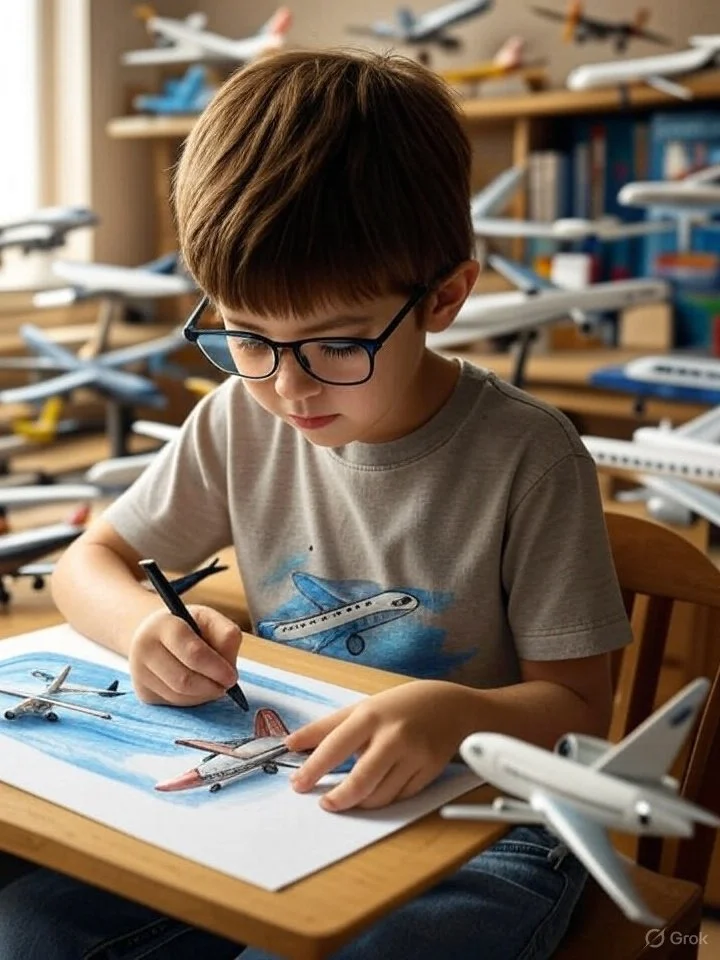
From the time I was a little boy…longer ago than I care to remember…my dream was to fly. I loved airplanes. My room was littered with all manner of model airplanes I had built. On my dresser, on my windowsill, and hanging from the ceiling by fishing line were replicas of everything from the Sopwith Camel to the B-58 Hustler…though the vast majority were World War II icons like the B-17 Flying Fortress and the P-51 Mustang. I read books about Claire Chennault and the Flying Tigers, Pappy Boyington and the Black Sheep Squadron, and the adventures of Chuck Yeager.
As an ROTC cadet in college, I allowed myself to dream of becoming an Army helicopter pilot; despite needing lenses to correct my nearsightedness, I took the the aptitude test and crushed it. Contingent upon passing a flight physical during summer training at Fort Riley, Kansas, I was slated to attend three weeks of cadet flight training at Fort Rucker, Alabama. Was it really happening? Was I going to make it?
No. My eyesight didn't meet the threshold for pilot training, and that was it. I was not going to be an Army pilot.
Years came and went, and I did not act on my dream of flying. I thought about a private pilot training, but that takes time and it takes money. For years, whenever I had the money, I didn't have the time…and vice-versa.
Fast forward to 2024, and a meeting with my financial advisor. Now I’m in my early 60s, and she asked me if there was anything I wanted to do, or anything I wanted to purchase that we needed to plan for. I really couldn't come up with much…I'm pretty satisfied with my life. But a couple of months later, it hit me. Maybe now was the time. Maybe now I was in a place where I could pull it off. We had a conversation, money was set aside, and I was off.
I set a very aggressive training schedule with the chief instructor at my school, planning to train three days per week. My work schedule permits me to train in the morning, and since it is commonly accepted that the fastest progress comes from regular practice, I decided to hit it hard. I took my first flying lesson on January 9, 2025.
In the beginning, progress came quickly. Everything was new, and it was easy to see rapid gains. That said, I was also my own worst critic at times, and beat myself up over beginner mistakes, despite my, well…being a beginner. Fortunately my CFI (Certified Flight Instructor), Adam, was better than I was at finding the good.
One day in particular comes to mind: We had been doing pattern work off of a different runway than usual, in a right-hand traffic pattern (also unusual), and the pattern was pretty full and the radio rather busy that day. Once we got done and were back in the office debriefing the flight, I remarked about something that I had done pretty poorly and was feeling pretty bad about (probably a landing, given my early struggles with them). He replied, “Remember that one downwind leg where the tower called you to do a 360 circle for spacing?” “Yes,’” I answered. He went on, “You were already flying right traffic off of a different runway. You got a radio call from ATC to do a maneuver. You were already flying the airplane safely, and you answered the radio call correctly and performed the maneuver as requested, also safely…all at the same time. There was a lot going on and you handled it all.” He was right. So instead of walking out of that lesson feeling like a failure, I walked out feeling good.
Still, as with all difficult journeys, the pace of early progress slowed and gave way to grinding out the work necessary to actually polish out the rough spots. While I took to in-flight maneuvers pretty readily, landings did not come easily at all, and I was very frustrated at my inability to smooth them out. But with the aforementioned work, I slowly began to get the kinks worked out. One day, Adam and I went out with the express intention of working on my landings. Much to my surprise, my first attempt was what some in the aviation world call a “greaser.” Smooth and slick, I set the airplane down as gently as it could be done, and Adam looked at me and said, “That was perfect.” I said, “Don’t jinx it!”
But I did another great landing right after that, and then another. After that third “greaser,” he said, “That’s three in a row. I don’t think I can jinx it now. I’m going to say a word that’s going to scare you…’solo’.” He was right. It did. Did he really think I was ready to solo? You know, to fly an airplane all by myself? He confirmed it in our debrief back in the office. “Next time you fly, expect to solo.”
The day came, and Adam said, “We’ll do a couple of laps together to get you warmed up, and then we’ll come in and shut down. Get out and stretch your legs a bit, and when you’re ready, go out and give me three touch-and goes.” We went around a couple of times, and taxied back to the hangar. I did as Adam said, and got out for a quick break. Then, with some more encouraging words from Adam and from our chief mechanic, Tim…I climbed back into the cockpit and began my startup checklist. A few minutes later, I had taxied out to the runup area, and completed that checklist, too. Then a couple of deep breaths, and I keyed the radio and said, “Lunken Tower, Cherokee 2710 Sierra holding short in the runup area, ready for takeoff. Student solo.” The response came back, “2710 Sierra, cross 25, clear for takeoff runway 21. Good luck.”
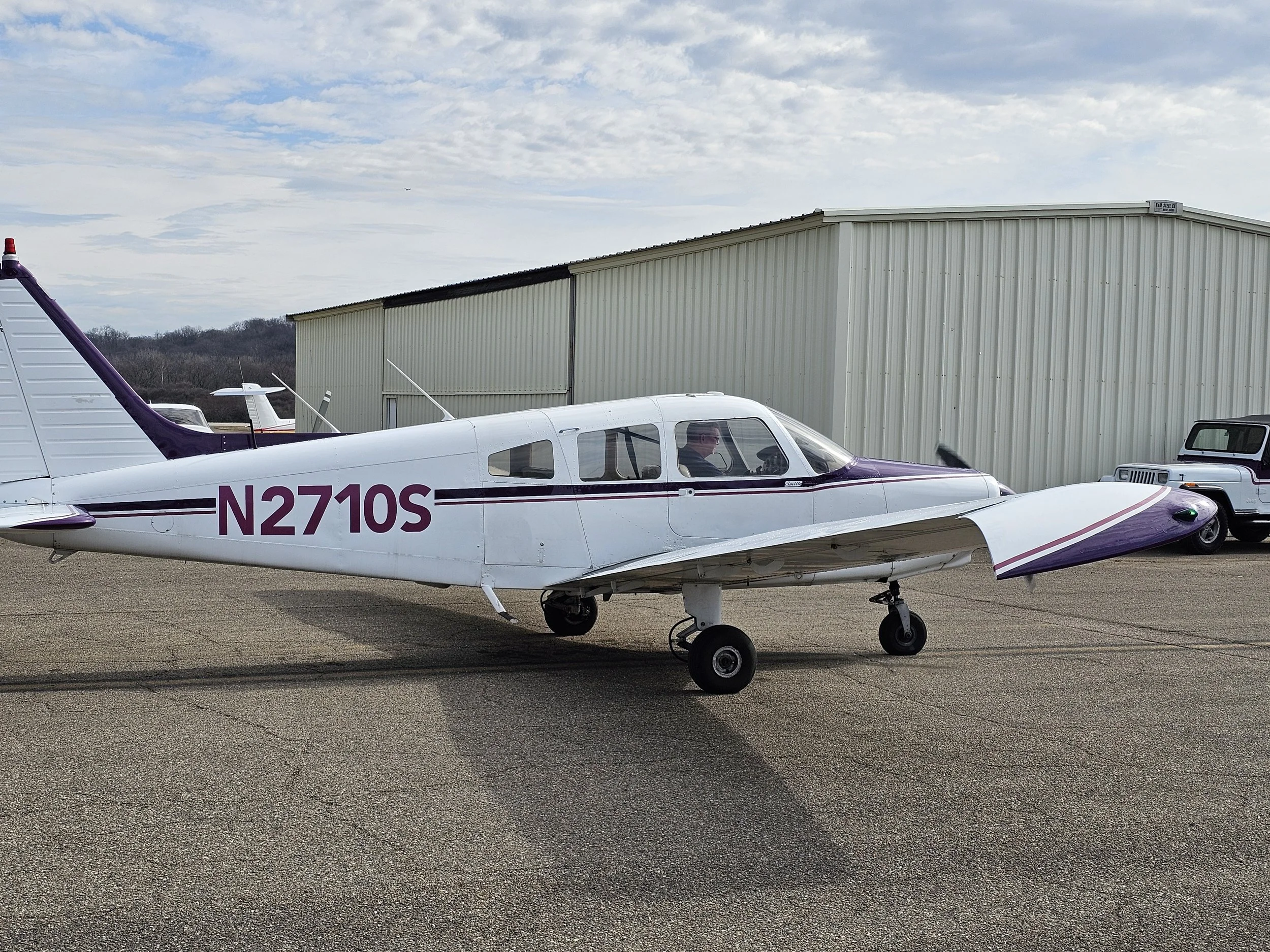
First solo…
I rolled out onto runway 21 and pushed the throttle all the way forward. A few seconds later, I was climbing away from the runway. I looked out the right window and could see Adam and Tim watching from the South Line. As I turned left into the crosswind leg of the pattern, I thought, “I don’t remember it being this bumpy before.” I was getting bounced around a little, and it was a little unnerving. But I was up there, and at least one landing was mandatory at this point. I turned downwind and hit pattern altitude, and then it was time to start configuring for landing. Reduce power, put in the first notch of flaps. Switches up, mixture full rich, engine instruments all still green. Begin descending and turning left to the base leg. Next notch of flaps. Keep descending, watch the airspeed. Turn to final, last notch of flaps. Pitch for airspeed, power for altitude. Maintain centerline, watch the glide slope. Come over the runway threshold, keep reducing power, round out the descent, power idle, flare, and…touchdown. Clean up the flaps, full power, take off and do it again.
Despite the turbulence, I continued and finished my first solo. Once it was done and I was back at the hangar, I felt kind of out-of-body while Adam did the traditional cutting of the shirt tails and Tim took the obligatory photos. It was a bit surreal…like a dream…but I had done it. I flew an airplane all by myself.
But it only got harder from here. On my next flight, I was to solo again, but this time with ten touch-and-goes. As fate would have it, the turbulence around the airfield was back as well. Still, I stuck to my training and my procedures, and worked through it. My landings were rough that day. On one landing, I bounced the aircraft three times, porpoising so badly I feared I was going to break something before I got it under control. But I did get it under control, and completed the flight. On to bigger things.
The bigger thing in question was cross-country flying. For private pilot training purposes, cross-country is any flight of at least 50 nautical miles, and as part of private pilot training, you must do five hours of solo cross-country, including at least one flight of a minimum 150 nautical miles. Fortunately, there was plenty of cross-country practice time with Adam, flying to different airports, both towered and non-towered. But eventually the day came when Adam stepped aside, and I once again climbed into the Piper Cherokee all by myself. Let me assure you, it was a whole different feeling from my previous solos. Instead of simply circling the airfield, never losing sight of the runway…this time I was putting the comfort and safety of my home airport in the rearview mirror, and setting out to find another one to land on. Alone.
To keep a long story from becoming even longer, I did it. I completed all my cross-country solo flying without incident…nothing major anyway. There were a few minor struggles here and there, but nothing that could not be managed, and I learned more and more as I worked through them. By the time I made my last landing back at Lunken after cross-country solo, I was beginning to actually feel a flicker of confidence. I was beginning to…just a little bit…feel like a pilot.
Then, a setback. A staffing situation at my job resulted in my having to cover 12 hour shifts for several weeks, which meant weekday flying was suddenly a non-option. With weekends already heavily booked at my flight school, I was effectively grounded until the work situation was resolved.
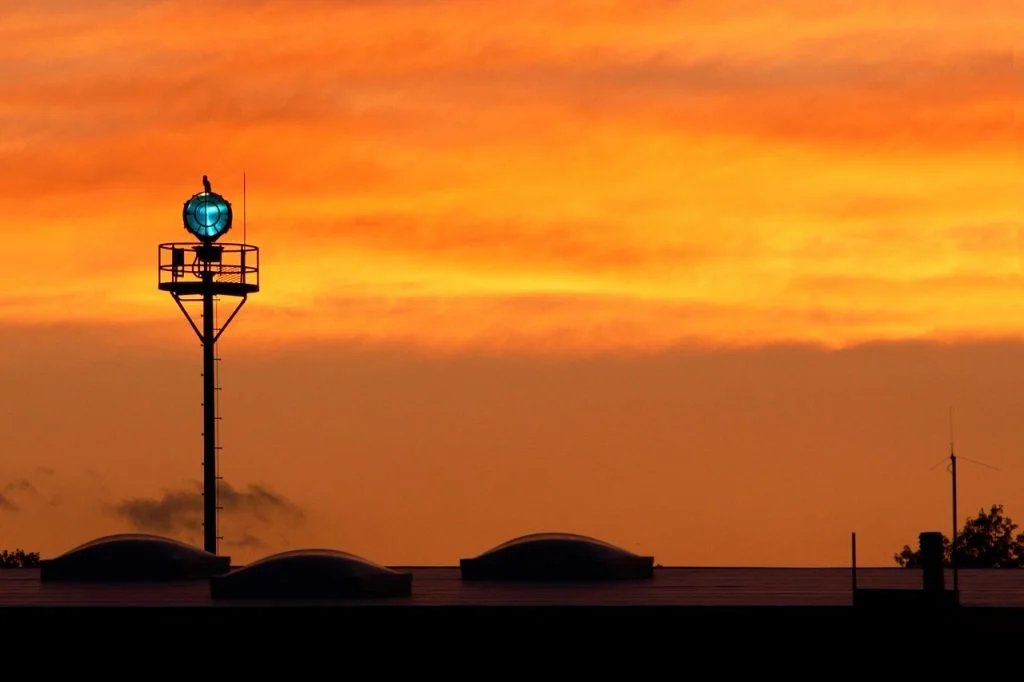
One exception was night flying. The private pilot training syllabus includes a mandatory three hours of night flying, which my instructor scheduled for a Saturday night in June. Night flying was amazing. High in the air over southwest Ohio near Cincinnati, the city lights put on a show. We even got to see King’s Island fireworks from above. But night flight comes with its own challenges. Although most airports are lighted, so is everything else, and the runway lights are really only visible from head on. This makes finding the airport a little tricky, as you might imagine. Counterintuitively, it turns out that what you’re really looking for is a dark patch in the midst of all those lights. If your intended airport has a rotating beacon, spotting that is a big help.
Then there’s landing at night. Although the runway is lighted, it’s typically only the runway boundaries (and maybe the centerline) that are lighted. The actual runway surface is not, so you really only see it when the landing light on your airplane hits it, and that’s only moments before touchdown. It’s a weird feeling. You just have to watch your airspeed and glide path, and put it between the lighted lines. If you’re lucky, there’s some approach lighting on final to help you line things up. Then there was taxiing the airplane in the dark which threw me a bit at first…until Adam reminded me, “just keep it between the blue lights.”
Another challenge I faced as I worked up to my checkride was the requirement to do three hours of “simulated instrument flying.” While instrument flying is a rating all its own, with 40 hours of required training and another checkride, private pilot students still have to familiarize with it. This is done by putting on what are called “foggles,” basically a set of safety glasses with the top half obscured. Initially, Adam would have me don the foggles and simply focus on keeping the airplane straight and level, which is tougher than it sounds when you can’t see the horizon, or anything else besides your instruments. Next came climbs, turns, and descents, all with no visual reference outside the aircraft. Then came “unusual attitude recovery,” which consisted of Adam taking the controls and maneuvering the airplane around, while I kept my eyes closed. Then I’d open my eyes (with the foggles on) and have to recover the airplane to straight and level flight from whatever position he had put it in…using only the instruments. It was a real awakening to discover how easily your inner ear becomes disrupted, causing your body to lie to you. You have to learn to ignore that and trust the instruments.
We were now into July, and now the focus was totally on preparing for my checkride…the final exam for my private pilot certificate. Checkrides are administered by Designated Pilot Examiners, or DPEs, who are authorized by the FAA to certify pilots. Consisting of both an oral exam and a practical, the DPE tests the student on overall aviation knowledge and flying skill. They typically last several hours, and before I knew it, mine was scheduled for August 8th.
This began the next setback. Without getting into the weeds of FAA regulations, applications, and certification paperwork, the bottom line was that my student pilot certificate had somehow gotten fouled up between my flight school and the FAA. The problem was that the dates on my student pilot certificate incorrectly showed an application date after I had flown all 10 hours of my solo time (including cross country)…invalidating all that time. The DPE could not even legally conduct the checkride and turned me away. I flew back to Lunken with my CFI pretty much in silence. It was a bad day…but it was about to get worse.
The effect of all this was that I then endured another 7-week layoff from flying while my school and the FAA went back and forth trying to figure out why my student pilot certificate was incorrect and what could be done to fix it. The end result was that the FAA refused to correct the dates and that was that. My 10 hours of solo flying were invalidated and would have to be repeated.
After discussing it with my instructor, we decided that solo cross-country flying would be the quickest way to rebuild 10 solo hours, so after yet another long pause in my flying, I went right back to a cross-country flight from Lunken to Morehead to Lexington, and then back to Lunken. I’m not going to lie…returning from such a long layoff directly to flying a long cross country solo (over 200 nautical miles) had me a little nervous. I shouldn’t have been…it was a great flight. The tricky wind currents around the hilltop airport in Morehead? Handled it. Flying into the busy Class C airport in Lexington? No problem. In fact, I picked right back up as if I had never been away, and it was a great confidence builder. Despite all the setbacks which led to this point, this was the day I can say that I began to actually feel like a pilot, and I walked away from the airplane that day with a little more swagger in my step.
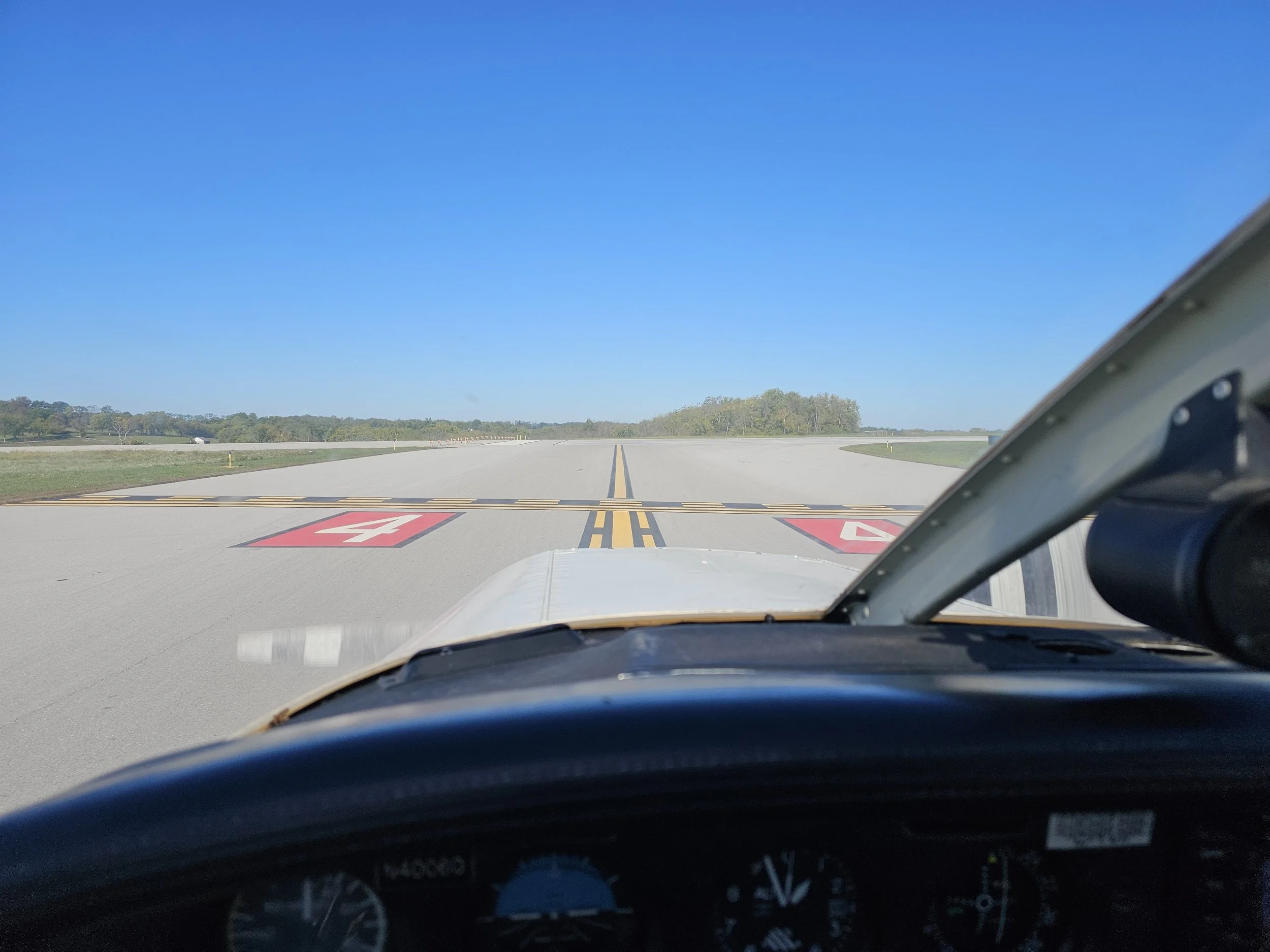
Holding short at KLEX…solo cross country
But by the time I got my solo hours re-flown it was getting into winter weather, and scheduling became more of a problem. Normally, winter weather makes for good flying. Colder, denser air makes engines run better and wings lift better. But this winter didn't cooperate. While I was able to log enough hours to stay sharp, making that, the weather, and everything else line up to make a checkride happen…just didn't happen.
Until it did. After all the speedbumps and detours, finally the day came. The last time I was this nervous was 40 years ago, on Monday of Jump Week at the U.S. Army Airborne School. On that day, as I stood up, hooked up, and shuffled to the door, I distinctly remember thinking, “Well, this is it. I am going to jump, and in a few seconds I will either have successfully completed my first parachute jump, or I will be dead.” And I jumped. Although the stakes today weren’t life-or-death, what was on the line was a decades old dream.
From the time I was a boy, it was a dream. But as T.E. Lawrence wrote, I acted my dream with open eyes, to make it reality. This I did. As of today, I’m a pilot.